Walking With Dinosaur


This time last week I was staring peevishly up a steep path from a Devon beach to a clifftop. It was the third such climb I’d stared at that day, and it wouldn’t be the last. My dad came up behind me, saw the trajectory of the path and swore quietly into his beard, before puffing determinedly off up the hill with the measured, rhythmic breathing of the Little Engine That Hoped It Still Could.

My dad and I have been walking the south coast of England a week or so a year for five years now, and have made it from Lands End almost to the Devon-Dorset border. He’s a perfect walking companion, and stoically endures my teasing, including my habit of referring to our annual hike as “Walking With Dinosaur”.

Dad is in great shape for a man of 65, albeit carrying the legacy of perhaps one more steak-and-red-wine dinner than is medically advisable. He’s still capable of walking 15-20 miles in a day if necessary, though we usually tend to stick to 10-13 miles, given the frequency of swearworthy cliffs on the coastal path. He’s also more than capable of holding his own in the piss-taking stakes, given that he taught me everything I know, then held quite a bit back in reserve in case I get uppity.

Spending up to nine hours a day on a trail together gives time to chat as father and son that is harder to come by the rest of the year, though I’d not pretend we necessarily use the time for deep philosophical chat. Dad is always ready with a joke or an interesting opinion (invariably more thought-through than my own), or, when necessary, silence. Though maybe my opinion of when his silence is necessary differs slightly from his own. Possibly because time in the company of parents often makes people revert to their sixteen-year-old selves, my current favourite trick is to say something deliberately provocative or needlessly offensive just as we start up a big hill, knowing that dad will lack the requisite puff to argue the point during the ascent. For some reason, this is particularly enjoyable if he agrees with the basic thrust, but I overstate the case to the point of being completely indefensible.

“Given the harm caused to vulnerable people from cuts to the welfare state,” I’ll begin as we start to climb, “It’d be best for us as a species if George Osborne were to slip in a pigpen during a photo op for the NFU. And for him to then be devoured: living, breathing, screaming, dying, by a horde of ravenous Gloucester Old Spots. Ideally they should start from the toes and work their way upwards, don’t you agree? Oh golly gosh, is that another climb? See you at the top!”

We’ve developed a routine whereby we talk over the issues of the day, I overstate something in a kneejerk way, for what I hope is comic effect, and he patiently corrects me, using anecdote, legal precedent and, from time to time, quadratic equations. I then wait until the bottom of the next big hill before restating my case, often with a gratuitous knob gag thrown in for good measure. Dad is, at least in this context, an admirably patient man.

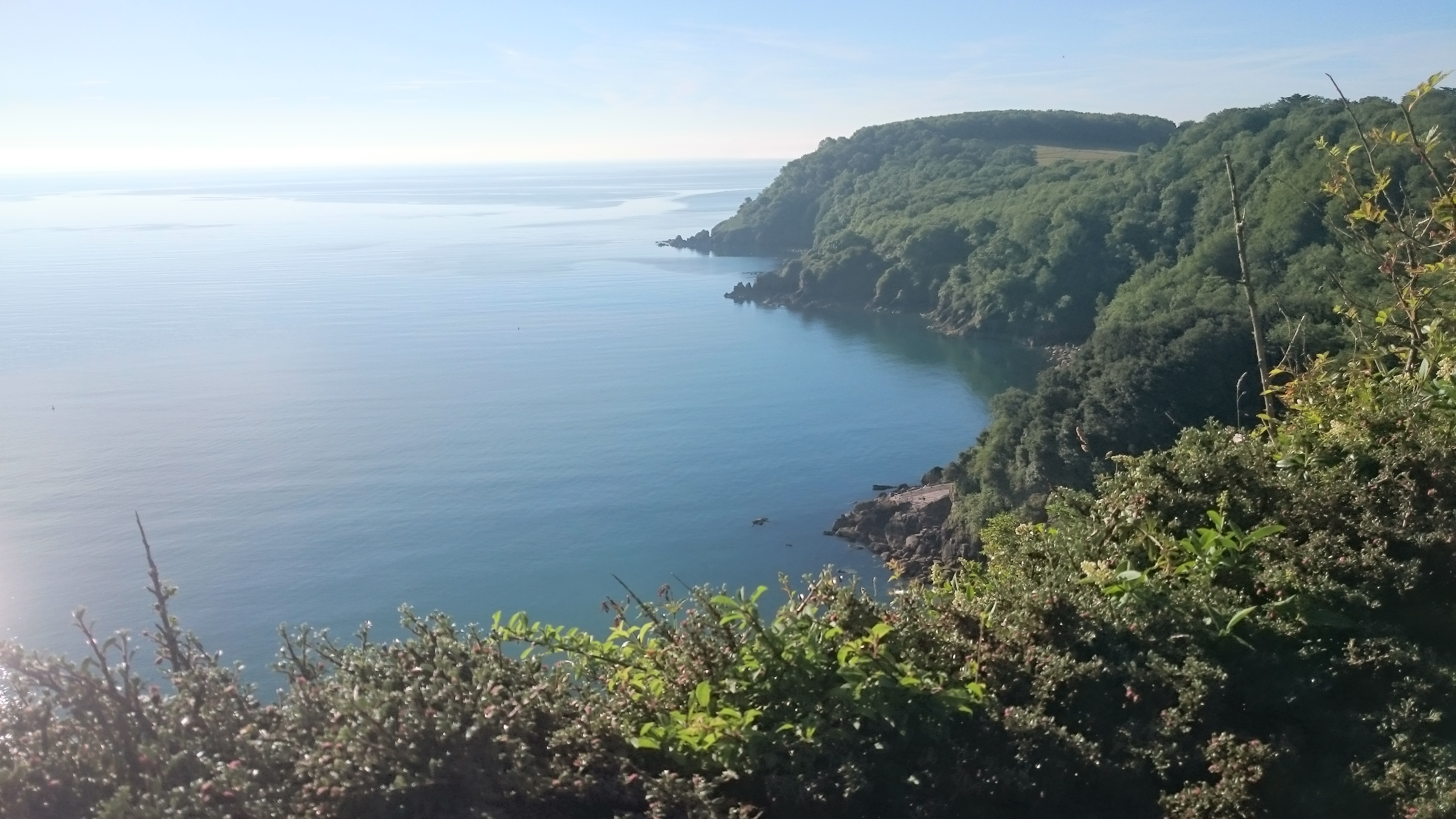
With a perfect walking companion, I’m lucky enough to also have a perfect location in which to walk. For all our occasional moaning about the up-and-down terrain, the south coasts of Devon and Cornwall are spectacular places to hike. Around corner after corner, clifftop meadows and wooded valleys give way to beautiful sandy coves (these sound like a P.G. Wodehouse description: “Old Biffy was known as something of a sandy cove…”).
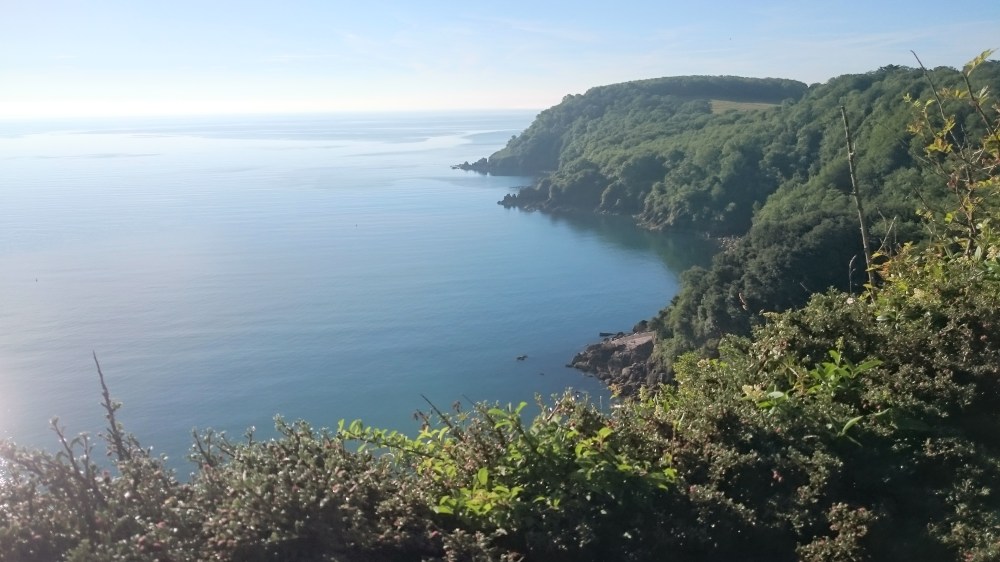
DSC_0134A few conurbations like Torquay and Plymouth aside, the paths mostly run along uninhabited coastlines looking out over clear blue waters, punctuated by occasional beaches or fishing villages with names like Porthfallus and Polpott. These often offer deeply agreeable cream teas or crab sandwiches. That said, one can’t criticise the newer, more developed bits of the coastline without risking sounding like David Bathurst, the author of one of our guidebooks. Although Bathurst’s guide is excellent on the specifics of which stile to climb over when the markings are overgrown, his book seemingly channels the art critic, pompous opinion-profferer and first-class snooty sneerer Brian “R” Sewell. Bathurst moans incessantly whenever the trail comes anywhere near a caravan park or amusement arcade, and God forbid that anyone young or working class might go within 500 yards of his beloved coastal path. Here is Bathurst on the nightlife of Torquay, cracking what he presumably thought was quite the humdinger of a gag:

“You should also bear in mind, if lodging in the resort, that it attracts a fair multitude of what The Rough Guide describes as ‘drink-sodden revellers’; indeed, your muddy gaiters and stripey bobble hat, while wholly acceptable on the windswept heights of Bolt Head, may look somewhat out of place in the kebab queue among the boob tubes, thigh-length boots and six-inch heels. And some of the women’s clothing is a bit radical too!”

Of course the reader thinks Bathurst is referring to women wearing boob tubes, but the twist is that he is implying they are cross-dressing men! What an hilarious misunderstanding, he really is a card! Or something that sounds like a card, anyway. You can imagine Bathurst walking through a caravan park, ostentatiously pinching his nose between thumb and forefinger, muttering “ghastly, my dear, simply ghastly!”

Despite the walk being something my dad and I decided to do together, the real unsung hero is my mum. Each year she comes along, sorts out the accommodation and ferries us to the beginning and end of each day’s hike. If my mum had been on Scott’s Antarctic expedition they’d not only have made it back from the Pole alive, she’d probably have found them a lovely igloo to stay in on the return journey with a barbecue area out the back and a play room for the kids. She finds beaches and cafes and medieval churches to explore at her own pace while we’re out (as she would say) walking a very long way to get to somewhere we don’t particularly intend on visiting. My wife and son now also come with us, and my sisters too on occasion, meaning that what began as a foolish bloke-project has turned into a really enjoyable annual family holiday. The others are great at accommodating our plans, and we make sure we keep a couple of days free to join them on family outings.

We hope to make it to Dover before my dad’s knees give out. We’re around a third of the way there in terms of mileage and have done some of the hardest walking in terms of terrain. I give us a decent chance, as his knees are probably in better nick than mine.

Walking the coastal path has been a great way to spend time with my parents, to get fit, and to spend time in a lovely part of the world. Next year we’ll be starting at Budleigh Salterton, which marks, appropriately enough for our Walking With Dinosaur tour, the start of the Jurassic Coast.

Total Wipeout – Imagining Armageddon

Over the last week or so I’ve spent a lot of time picturing a desolate world of blackened ash under burning skies, with almost nothing left alive. (This fact is only subliminally connected to despair over the arrival of George Osborne’s thousand-year Reich.)

I’ve finally got around to reading a couple of books I’ve been meaning to get to for ages. The first was The Road by Cormac McCarthy (I know, it’s a decade old and they made a film of it with the Lord of the Rings bloke that was a bloke and not a hobbit or a wizard or whatever. No, not Sean Bean, the other one. I just never got round to reading it, OK?) The other was Command and Control, by Eric Schlosser. The first imagines a world after an unspecified Armageddon (possibly nuclear, though radiation isn’t mentioned); the second gives an awful lot of detail on how lucky we all are that a nuclear apocalypse was never set off by accident.

I had just turned seven when the Berlin Wall came down in 1989, so didn’t grow up expecting to be vaporised any second, as the generation before must have done. Throughout my teenage years, the merciless red army that kept me awake at night as it crushed hope beneath its merciless jackboots was Alex Ferguson’s Manchester United. And even the most hysterical football fan would struggle to say they were worse than a nuclear holocaust.

The prospect of Armageddon by some disaster has always held a ghoulish fascination for me, so the Schlosser book in particular was grist to my horrible mill. It is packed with stories of B-52 bombers laden with atomic or hydrogen bombs catching fire on the runway, or crashing, and in at least one instance a crew member accidentally dropped a bomb out of his plane after grabbed hold of the bomb-release handle by mistake. In one incident, in North Carolina in 1961, a four-megaton bomb fell from a burning aircraft and every arming mechanism on the bomb was activated apart from one single low-voltage switch – a safeguard that subsequently failed on a different flight a year later. A nuclear explosion would have been bad news for anyone within the blast zone, clearly, or anyone within a radioactive fallout zone that could have reached New York, depending on the wind. But maybe the biggest risk would have been a retaliatory strike on the USSR on the assumption that the US was under attack.

The book is full of stories of accidents, explosions, and military personnel ‘goofing around’ and getting high while handling nuclear weapons. One bomb disposal technician even apparently smuggled a dummy weapon out past security by slinging it under a tarp in the back of a pickup truck to disassemble in front of his girlfriend, with the training bomb taken from a bunker where real and dummy weapons were stored alongside one another. Interwoven between these stories is a blow-by-blow account of a missile that exploded spectacularly in its silo in Arkansas, killing one serviceman and injuring a number of others, although again without detonating its nuclear payload. The disaster occurred because one worker dropped a socket from a wrench that hit the missile and ruptured a fuel tank.

In some ways Command and Control is strangely reassuring, even though it portrays the history of American nuclear safeguarding as like a Marx Brothers farce presided over by the sort of people who’d keep a loaded gun next to their alarm clock with the safety off ‘just in case’. Despite all the slapstick japes the military was getting up to with dangerously under-safeguarded bombs, nothing ever went boom. It turns out it’s quite difficult to set off an atomic bomb accidentally, although for a very long time it was nowhere near difficult enough. And despite sensors falsely alerting commanders of an all-out attack because a technician put a war-game training tape in the machine, and despite senior generals actually advocating an unprovoked nuclear attack on the USSR from time to time for strategic reasons, the button was never pushed.

But as Schlosser points out, the litany of fiascos in his book relate primarily to the American arsenal, which for all its faults, has mostly had leading technology and a better general industrial safety record than, say, the USSR, China, India or Pakistan, not to mention marginally saner leaders than, say, North Korea. So although the specific risk is much lower that the whole of South East England will end up looking like a terrible barbecuing accident, there is still plenty out there for a worrier to obsess morbidly over.

Though I do like a good “what if” Armageddon scenario, partly fuelled by reading quite a few John Wyndham books as a teenager, I’m aware that in my version I’m always around to witness the aftermath. I’d always assume I’d be one of the survivors, scarred but unbowed, probably striding through the ashen landscape and heroically leading a band of predominantly-female stragglers who’d be enthusiastic to help me rebuild the human race. In actual fact, of course I’d far more likely just constitute part of the ash blowing around the place and getting stuck in the nostrils of someone actually heroic.

In Wyndham’s post-apocalyptic world, the survivors generally maintain stiff upper lips despite the peril, and enough of them maintain a basic level of decency to keep some form of civilisation together. It’s important for narrative to have some survivors, and not just a description of a shattered planet, observed by no-one. The Road is about as close as you can get to this latter model while still being an actual story with characters. The protagonists encounter no-one alive for much of the story, they’re gradually starving to death, and the few times they encounter other survivors, the people they meet tend to want to kill them and eat them. It’s hard to see how anyone left alive is doing anything but putting off the inevitable.

It’s not a happy book, but it’s very well written and it drags you along with it, wondering if somehow the author can conjure up a happy ending. *Spoiler alert*, he doesn’t. Not really. It’s bleak pretty much to the end, but an upbeat ending would have felt forced. Even the slight ray of hope they give the boy in the last couple of pages seems a bit contrived, though probably necessary. For the ending to be in keeping with the rest of the book he’d have had to be captured and harvested for his flesh by starving murderers or he’d just have had to lie down in a puddle of damp ash, bellowing like a wounded donkey and waiting for death. I’m not sure I could have taken that.

It’s an odd thing, and I’m sure it’s been pointed out elsewhere, that there seems to be nothing for anyone to eat in McCarthy’s wilderness but old tins and other people. Whatever the reason for his particular apocalypse (and he probably chose to keep it vague to stop this sort of pedantry) it’s hard to imagine what could have killed every single insect, worm, invertebrate and so on, while still leaving humans alive. Still, it’s a minor gripe and it doesn’t spoil the book.

Having read both of McCarthy’s and Schlosser’s books, I feel like I’ve maybe binged a bit on the hows, whys and what-nexts of the end of the world as we know it. Maybe now it’s time to move onto something lighter.

Two weeks on: I can just about face thinking about the election now

It’s been two weeks now since the UK voted overwhelmingly* for five years of a majority Conservative government. We’ve chosen to spend our next five years with our balls in a crocodile’s mouth, because it promised it totally, definitely won’t bite this time like it did all those other times. Still, the crocodile looks majestic eating a bacon sandwich, and that is clearly what really matters.

Terrifyingly, some 13% of electorate in the UK voted UKIP, and 14% in England. This means that more than one in eight voters plumped for a party whose entire manifesto consisted of the phrase “bLAmE FoRRinnERs” written over and over in crayon, Winnie-The-Pooh-style handwriting, with several of the letters written backwards.

Labour’s defeat has prompted the traditional soul-searching. Various Blairites have clambered atop their piles of money with loudhailers to announce that the party lost because it was insufficiently “aspirational” or “pro-business”. Presumably they felt that the demographic of very wealthy ex-Cabinet Ministers and political advisers was not sufficiently represented in politics.

Ultimately, the result seems to have come down to the perception of Ed Miliband as someone unfit to be Prime Minister. This may well have been an accurate perception, although unfitness to govern for reasons of incompetence, megalomania or a total indifference to human life hasn’t stopped any other Prime Minister in my lifetime. But it’s hard to escape the role the media played in the campaign. They just stopped short of mocking up a picture of Ed Miliband dancing on the grave of Princess Diana with Madeleine McCann under his arm, but you suspect only after much heated debate on the pictures desks.

The hatchet jobs on any credible party even a fraction to the left of centre (or insufficiently right of centre) will be something Labour has to work out how to counter if they are ever to regain power, as massive right-wing bias seems to be the price we have to pay for enjoying a free media. Privately-owned media outlets almost inevitably accumulate into the hands of a very small number of very wealthy people. As such, newspapers will tend to support whichever party seems best to represent the interests of paranoid elderly billionaires, and decry anything less than total subservience as the bastard spawn of Joseph Stalin, Fidel Castro and Vlad the Impaler.

Meanwhile, as we await the apocalypse, the new Tory Cabinet has been announced. John Whittingdale, who hates the BBC, has been named Culture and Media Secretary; Michael Gove, who doesn’t believe in human rights, has been named Minister for Justice, and Jeremy Hunt, who believes in homeopathy and co-authored a book claiming the NHS is “no longer relevant” remains as Health Minister. Presumably the Science Minister believes dinosaur fossils are a test from God, the transport minister believes in flying carpets and the Foreign Secretary flatly denies the existence of Norway.

Still, the people* have spoken, and that’s what we’ve got for five years. I just hope that when they realise what they’ve done, anyone who voted Tory has a severe word with themselves. Preferably a very short, very rude word.

* just under 11,500,000 people voted Tory, from a UK population of around 64,000,000, or a little under 18% of the populace. Included in this figure are children who can’t vote, because it makes the proportion look smaller and therefore makes me feel better. And anyway, it’s their generation who’ll have no schools or hospitals left, so let the toddlers speak! But let me interpret.